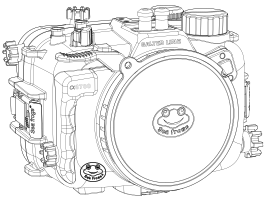
Salted Line Sea Frogs Underwater Camera Housing for Sony A6700 Manual
WELCOME!
Thank you for choosing Salted Line Sea Frogs series housing. Please review this manual thoroughly to ensure optimal performance and avoid potential issues.
This manual applies exclusively to the Salted Line Sea Frogs series A6700 underwater camera housing.
The product must be used strictly according to the instructions provided. The manufacturer assumes no responsibility for damage or injuries resulting from improper use.
The illustrations in this manual are for general guidance. Always refer to the actual product for precise details.
The content of this manual is subject to change without prior notice.
We appreciate your purchase and are confident you will enjoy using your new underwater camera housing!
Stay Aware, Stay Safe
Precautions
Conduct a watertight test without the camera inside the housing before the first use, after servicing, or after any port or O-rings changes
Only use the silicone grease provided by Sea Frogs for the rubber O-ring! Do not use grease from other brands.
Stop using the housing immediately if you detect any leakage. Contact support@seafrogs.hk.
When traveling by air, keep the housing open to avoid pressure buildup, which makes it difficult to open later.
Avoid opening the housing in wet or sandy conditions. Keep the interior dry and tidy to prevent leaks and malfunctions.
Keep the housing out of direct sunlight to prevent overheating and damage to the polycarbonate material.
Store the housing in a cool, dry location, away from high humidity or direct sunlight.
Moving quickly between areas with significant temperature differences can cause condensation inside the waterproof case.
Keep the housing out of direct sunlight to prevent overheating and damage to the polycarbonate material.
Always dry the glass or acrylic ports and the LCD window using a soft cloth to prevent stains or salt residue from damaging the surface. Do not use solvents to clean the port, viewfinder, or LCD window.
If the housing won’t be used for a long time, remove the O-rings and store them separately. To ensure a tight and waterproof seal, replace the O-rings at least once a year.
Rinse the product with fresh water after use in saltwater. At the end of each dive day, remove the port from the housing to prevent it from getting stuck.
Store the housing only after thoroughly cleaning and drying its surface.
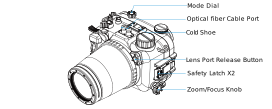
Do not attach an external monitor directly to the housing using the “cold shoe” mount. The housing’s “cold shoe” mount is intended for flashlights, action cameras, and other small, lightweight accessories.
This section provides an overview of the technical specifications for your Underwater Camera Housing. It's your go-to resource for understanding the device's capabilities and limitations, ensuring you use it safely and effectively.
Operating temperature
0-40℃ (32-104℉)
Water resistance
40 meters / 130 feet
Buoyancy
Extremely positive (Hand strap required)
Housing bayonet mount type
90mm
Product dimensions, Weight (Body Only)
W195 x D125 x H150mm, 1090g
W7.68’’ x D4.92’’ x H5.91’’, 2.4lbs
Waterproof construction
O-ring seal
Material
Polycarbonate, Stainless steel, Silicone
Key Features
Detachable shutter grip with two-stage trigger (sold separately)
Vacuum Check System port
Inbuilt leak detection sensor
Interchangeable port system
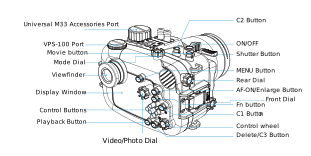
Universal M33 accessories port
Dual Fiber-Optic port (Sea & Sea type)
Two stainless steel mounting plates 1/4’’ thread
The reinforced metallic bottom plate
Dual-sided metal latch locking system
Detachable Pistol grip with 2-stage trigger (optional)
Push the red button of the safety lock to the neutral position and hold it there.
Simultaneously pull part A outward and backward.
Once part A reaches a certain position, pull part B outward, ensuring that the round shaft of B safely disengages from the metal hook on the back cover, completing the unlocking of a single safety lock.
After both the left and right safety locks are unlocked, remove the back cover.
Align the back plate with the main housing body and gently press it into position.
Visually inspect the housing to ensure the O-ring isn’t pinched and that a consistent seal exists all around.
Push part B inward until the round shaft securely engages with the metal hook on the housing body.
Push part A forward and inward to lock the mechanism into place.
The red safety button should automatically return from the neutral position to the locked position to secure the safety lock.
Repeat the same steps for both the left and right safety locks.
The red safety button should automatically return from the neutral position to the locked position to secure the safety lock.
Pull up both locks to make sure they’re fully engaged and securely fastened before use.
Visually inspect the closed housing to ensure the O-ring isn’t pinched.
Step-by-step guide to correctly installing and removing lens port. Proper technique is crucial to prevent damage to your equipment and ensure optimal performance.
Lens Port Installation
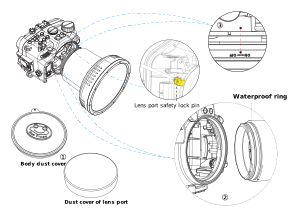
Remove the dust caps from the housing body and the lens port.
Check the groove on the housing body and lens port O-ring to ensure there is no damage or debris. Remove the O-ring (avoid stretching it!!!), apply a small amount of silicone grease, and then reinstall it into the groove.
Align the lens port’s positioning point with the housing body’s corresponding point. Push the lens port firmly, then rotate it clockwise until fully secured. If needed, use a screwdriver to install the safety lock pin inside the housing, ensuring you use the correct screwdriver to avoid damaging the screw.
Remember to use a tiny amount when applying grease to your O-rings. A thin, even layer is sufficient for the O-rings to shine without any visible grease patches. Over-lubricating can attract debris and potentially interfere with the sealing function of the O-rings.
Lens Port Removal
If the safety lock pin is installed, use a screwdriver to remove it from the housing. Ensure you use the appropriate tool to avoid damaging the screw.
Press the lens port release button and twist the lens port counterclockwise to detach it.
We recommend putting the camera into the housing in a room with low humidity and minimal dust. Avoid reopening the housing on a boat or near the shore.
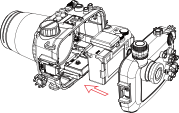
Move the locking lever on the housing tray to the “open” position. Then, slide out and remove the camera saddle from the housing.
Secure the saddle to the camera by tightening the screw (using a coin) into the tripod socket of the camera.
If needed, attach the appropriate zoom/focus gear to the camera lens. (For some lenses, it is necessary to detach the lens before installing the gear).
Before installing the camera into the housing, align the on/off, photo/video/S&Q mode dials on the camera and the housing.
Mount the camera by sliding the attached saddle along the housing’s rail until it cannot go any further. Lock the camera in place by turning the locking lever to the “lock” position. Ensure that all housing controls are properly engaged.
When installing the camera with the lens and zoom/focus gear attached, press down on the zoom/focus gear until it is securely in position. Make sure the zoom/focus controls are fully engaged.
We suggest installing the camera inside the housing in a low-humidity, dust-free room. Avoid reopening the housing on a boat or near the shoreline.
HDMI Support
To connect an external underwater monitor via an HDMI cable, unscrew the M33 accessory port cap from the camera housing (use the M33 to M16 or M33 to M24 step-down adapter if needed), plug the cable into the accessory port, gently push the connection head into the accessory port until it cannot go any further, then tighten the screw.
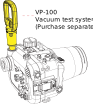
If you purchase the Sea Frogs VPS-100 Pre-Dive vacuum test system (sold separately), you can do an instant waterproof test. The vacuum test system manual includes complete instructions.
Note: To avoid accidents and equipment damage, always complete a waterproof test before using the camera housing underwater.
WARNING: THIS ACCESSORY IS NOT MEANT TO BE USED UNDERWATER AS PER MANUFACTURER INSTRUCTIONS! ANY ATTEMPT TO DO SO CAN CAUSE EQUIPMENT LOSS AND IS NOT COVERED BY THE WARRANTY!
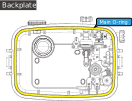
Before each dive, carefully inspect the waterproof housing’s main (backplate) and port O-rings. If the O-ring has any debris, remove it and clean it with fresh water, then dry it using a lint-free soft cloth.
After cleaning, each O-ring should be lubricated with waterproof silicone grease. When applying grease to the O-rings, use only a tiny amount. A thin, even layer is sufficient to make the O-rings shine without visible grease patches. Over-lubricating can attract debris and potentially cause leakage.
If the housing will not be used for an extended period, remove the O-rings, lubricate them, and store them separately.
All housing O-rings must be replaced at least once a year or after 50 uses, whichever comes first.
Note: Do not forcibly remove or use sharp, hard metal objects to remove the O-rings, as this may damage them or the case groove, leading to water leakage. DO NOT STRETCH THE O-RINGS!
The O-rings for the the M33 accessory port, VPS100 opening and shutter grip plug are maintained like the main O-rings.
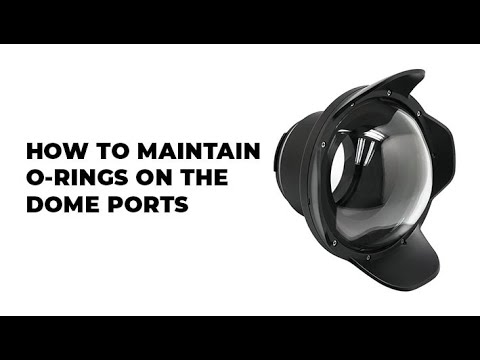
For Dome ports O-rings Maintenance (Not applicable to flat ports) please watch the following video:
Steps to Maintain main (backplate) and port O-rings:
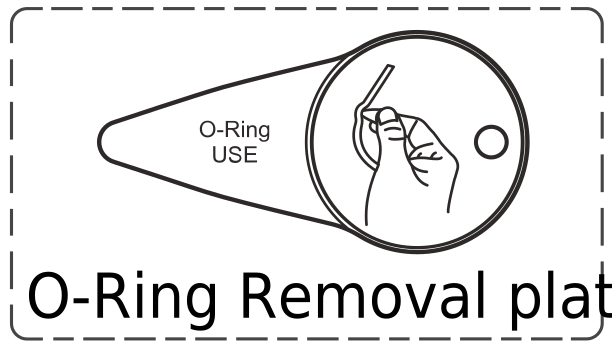
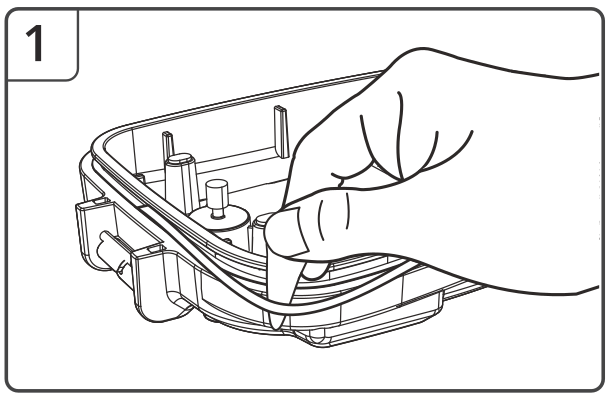
Use the provided O-Ring removal tool to take out the O-Ring.
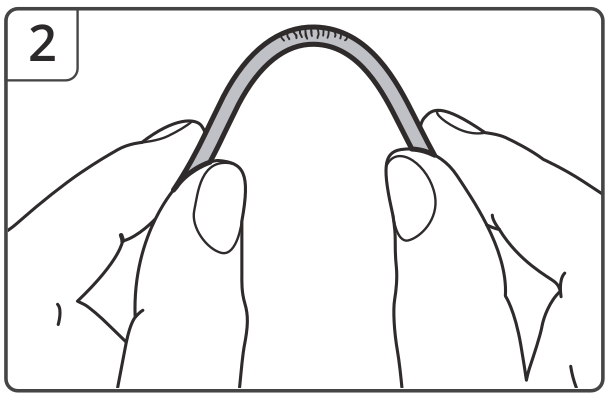
After cleaning, reapply the silicone grease to the O-ring. Use your fingers to distribute the grease evenly.
Check the groove of the backplate or port for debris. If debris is present, clean it using a lint-free soft cloth. Reinstall the lubricated O-ring back into the groove.
Do not stretch the O-rings.
Inspect the O-ring, remove old grease and debris, and clean it with fresh water. If the O-ring is damaged, replace it with a new one.
Steps to Maintain the secondary (housing body) O-rings:
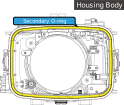
Unless absolutely required, keep the secondary (housing body) O- ring in place. Instead, simply wipe it clean and apply silicone grease without removing it.
To install the secondary (housing body) O-ring, first ensure the groove on the housing body is completely dry. Carefully remove all grease from the O-ring without stretching it, then install it into the groove. Please note: even small traces of grease on the O-ring or in the groove can prevent proper installation.
Lubricating Push Buttons
The push-button O-rings are designed to last the lifetime of the housing when serviced regularly
Press and hold the push button fully.
Apply a small amount of silicone grease at the base of the push button shaft inside the housing.
Press and release the push button several times to distribute the lubricant into the O-ring.
If a push button becomes difficult to press or sticks when depressed, soak the housing in warm, soapy water for a few minutes. Then, operate the push button to restore functionality.
To prevent the buildup of salt, sand, or debris, flush the push buttons with fresh, clean water after every use. While submerging the housing, depress each push button to ensure proper cleaning.
Use only original Sea Frogs spare O-Rings and silicone grease.
Ensure the O-Ring is flat and not twisted when reinstalling it into the waterproof case groove.
Recheck the O-Ring and groove after installation to ensure no debris is attached.
Replace O-Rings at least once a year or after 50 uses to maintain the product’s waterproof performance.
After-Use Maintenance
Rinse the housing thoroughly in fresh water. While submerged, rotate the housing controls and press each button several times to flush out any salt or debris, ensuring smooth operation for future dives.
Use compressed air to remove any remaining freshwater from all external cavities of the housing, paying special attention to buttons and knobs.
Store the housing in a shaded area, protected from impact and overheating. If the shade is unavailable, cover the housing with a light-colored towel or cloth.
Treat the lens port surface like a camera lens. After use, rinse and gently dry the outside of the lens port to prevent water spots. Use only a soft cleaning cloth to avoid scratches. For cleaning, use a mild soap solution.
Proper storage of your underwater camera housing is crucial for maintaining its functionality and longevity
Post-Dive Cleaning
After each dive, remove the camera and close the waterproof housing. Soak it in fresh water for 15-30 minutes, operating all buttons and knobs to prevent salt buildup. Use compressed air to remove any remaining freshwater from all external cavities of the housing, paying special attention to buttons and knobs. If compressed air is unavailable, position the housing to allow any remaining water to drain naturally by gravity. Thoroughly clean and dry with a soft cloth.
Storage Environment
Store the housing in a dry, well-ventilated area away from direct sunlight.
Avoid Extreme Conditions
Do not store in high temperatures, cold, or humid places, and keep away from naphthalene chemicals or insecticides.
Long-Term Storage
If not using the housing for an extended period, remove the main O-Ring, lubricate them and store it separately in a plastic bag.
Our commitment to you extends beyond the purchase. Here's what you need to know about our after-sales service
Warranty Period
The product comes with a limited warranty period of 12 months from the date of purchase.
Note: The warranty does not cover O-rings
Warranty Repair Services
During the warranty period, the company will provide free repair services if the product is used according to the “Operating Instructions” and hardware failures occur due to product quality issues.
Please note Shipping costs to and from our service canter are not covered under the warranty and must be paid by the customer
Paid Repair Services
The following circumstances during the warranty period will result in paid repair services:
Failures or damages caused by incorrect operation or use in environments outside the product’s specifications.
Failures or damages caused by unauthorized disassembly, repair, or modification of the product.
Failures or damages caused by natural disasters, accidents, or other force majeure events after purchase.
Damages caused by improper maintenance by the customer.
Please note The customer is responsible for all shipping costs to and from our service center.
Post-Warranty Repair Regulations
For products requiring repair after the warranty period, the company will charge the cost of replacement parts. Before proceeding with repairs, the customer will be notified of the repair charges.
No repairs will be undertaken if the company’s technical engineers determine the product is too severely damaged or unrepairable.
Liability Disclaimer
The company is not responsible for any product damage or other property loss caused by improper operation or failure to follow the operating instructions.
Please note The customer is responsible for all shipping costs to and from our service center.
Address
5/F, 25 Hart Avenue, Tsim Sha Tsui, Kowloon, Hong Kong